
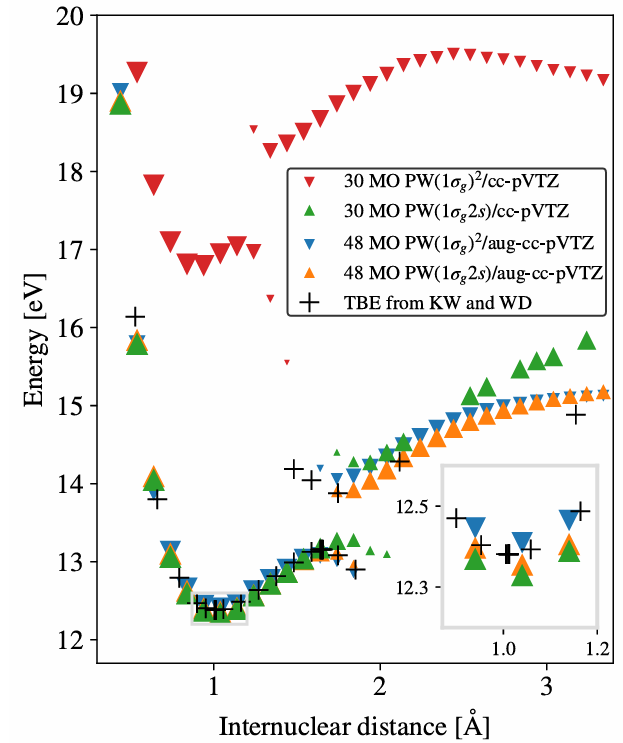
We are excited to announce the latest results from the collaboration with our Icelandic friends from theoretical chemistry as new preprint on arXiv. Our joint work tackles the long-standing challenge of accurately describing Rydberg excited states—molecular states characterized by extremely diffuse electron distributions that are poorly captured by standard atomic basis sets. The study introduces a state-specific orbital optimization in plane-wave Hartree–Fock calculations, followed by Neural-Network Configuration Interaction (NNCI) to achieve near-full-CI accuracy with dramatically reduced determinant spaces.
Key contributions include:
- Orbital optimization for excited states: Demonstrated to substantially improve convergence and accuracy for diffuse Rydberg orbitals (e.g., 2s in H₂) compared to traditional aug-cc-pVTZ and aug-cc-pVQZ approaches.
- NNCI extension to excited states: An efficient, iterative, machine-learning-based selective CI scheme that reproduces benchmark results for NH₃ and H₂O Rydberg states with only ~10⁵ determinants—five orders of magnitude fewer than full CI.
- Results: Excitation energies for 3s, 3pₓ, and 3p_y states are in close agreement with both experiment and high-level theoretical benchmarks (EOM-CCSDTQ, exFCI), confirming the effectiveness of the combined plane-wave + NNCI strategy.
Authors: Gianluca Levi, Max Kroesbergen, Louis Thirion, Yorick L.A. Schmerwitz, Elvar Ö. Jónsson, Pavlo Bilous, Philipp Hansmann, and Hannes Jónsson
Date: October 30, 2025 (accepted in JCTC on February 25, 2026)
arXiv: https://arxiv.org/abs/2510.26751